
Navigating the Arizona SMI System
The system won't explain itself to you. We will. This guide walks you through every step — from getting the SMI designation to accessing services, understanding your rights, and knowing who to call when the system fails.
Built by families who have been through it — so you don't have to figure it out alone.
The Roadmap
Your Step-by-Step Guide
When you're thrown into crisis, you need a roadmap — not a runaround. Here's the path forward.
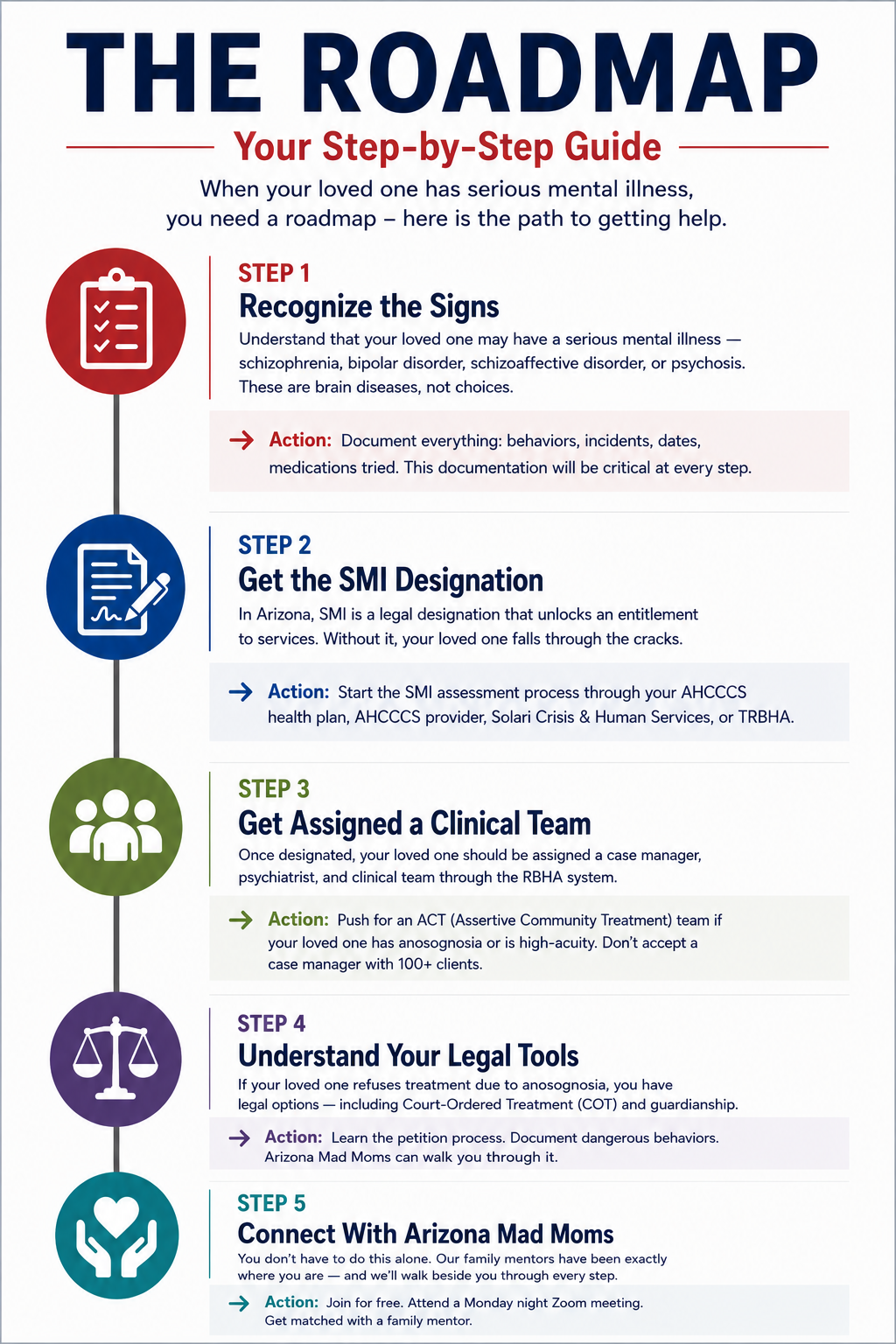
Recognize the Signs
Recognizing serious mental illness early — and understanding what you are seeing — is the first and most important step. Many families spend months or years trying to explain away the symptoms before getting a clear picture of what is happening.
Learn to Recognize the Signs →→ Action: Document everything: behaviors, incidents, dates, medications tried. This documentation will be critical at every step.
When It's an Emergency
Crisis Resources — Know Before You Need Them
Don't wait until you're in crisis to learn these numbers. Save them now. Share them with your family.
Suicide & Crisis Lifeline
Call or text 988 for immediate crisis support. Available 24/7. Trained counselors can help de-escalate and connect you to local resources.
For Spanish: Press 1 after dialing 988
Psychiatric Emergency
If there is immediate danger, call 911. Specify: "This is a psychiatric emergency. My [relationship] has [diagnosis] and is [specific dangerous behavior]."
Request a CIT (Crisis Intervention Team) trained officer if available
Crisis Text Line
Text "HELLO" to 741741 to connect with a trained crisis counselor via text message. Available 24/7 for anyone in crisis.
Mobile Crisis Teams
Contact your RBHA to request a mobile crisis team. These teams can respond in the community to de-escalate psychiatric crises without law enforcement when possible.
What to Do During a Crisis — A Family Checklist
Know Your Rights
Your Family's Rights in the System
The system won't volunteer this information. You have to know it — and demand it.
You Have Rights Too
The system focuses on the rights of the individual with SMI — as it should. But caretakers have rights too. You are not invisible. You are not disposable. And you deserve to be treated with the same dignity you fight to secure for your loved one.
The Right to Be Heard
You have the right to be listened to by treatment providers, case managers, and the behavioral health system. Your observations, concerns, and knowledge about your loved one's condition are critical to their care — and the system must take them seriously.
The Right to Information
You have the right to receive clear, timely, and accurate information about your loved one's diagnosis, treatment options, medications, and prognosis — within the bounds of HIPAA. If you are a legal guardian, you have the right to full access to medical records and treatment plans.
The Right to Be Included in Treatment Planning
You have the right to participate in the development and review of your loved one's Individual Service Plan (ISP). Your input as a caretaker is not optional — it is essential. If providers exclude you, escalate to the RBHA.
The Right to Safety
You have the right to live without fear of violence or harm from your loved one's untreated symptoms. The system has a responsibility to provide adequate treatment, housing, and crisis intervention — not to dump dangerous situations onto families. If you are in danger, call 911 and specify it is a psychiatric emergency.
The Right to Respite
You have the right to take a break. Respite care is an entitled service under the SMI system in Arizona. You can request temporary relief from caregiving through your RBHA — and you should. Caregiver burnout is real, and you cannot care for your loved one if you are broken.
The Right to Your Own Health & Wellbeing
You have the right to prioritize your own physical and mental health. Caregiving for a person with SMI is one of the most demanding roles a human being can take on. Seeking therapy, joining support groups, setting boundaries, and saying 'I need help' are not signs of weakness — they are acts of survival.
The Right to Grieve
You have the right to grieve the life your loved one — and your family — was supposed to have. Ambiguous loss is real. The person you knew before the illness may not be the person in front of you today. You are allowed to mourn that loss while still fighting for their future.
The Right to Advocate Without Retaliation
You have the right to file grievances, demand accountability, escalate complaints, and advocate loudly for your loved one without fear of retaliation from providers, facilities, or the system. If you experience retaliation, document it and report it to AHCCCS and Arizona Mad Moms.
The Right to Be Free From Blame
You did not cause your loved one's serious mental illness. SMI is a biologically-based brain disease — not a parenting failure, not a character flaw, not a choice. You have the right to reject any provider, system, or person who implies otherwise.
The Right to Community & Support
You have the right to connect with other families who understand. Isolation is one of the most devastating consequences of caregiving for someone with SMI. Organizations like Arizona Mad Moms exist because no caretaker should have to navigate this crisis alone. You belong here.
From Our Community
"Mothers have become the nation's default asylums. We didn't sign up for this — but we refuse to abandon our children. The least the system can do is recognize that we have rights too."
— Arizona Mad Moms
💡 How to Use This Bill of Rights
- →Print it and keep it with your documentation — reference it when speaking with providers and case managers
- →Share it with your loved one's treatment team so they understand your expectations
- →Bring it to ISP meetings and demand that your role as caretaker is acknowledged and supported
- →Use it as a foundation when filing grievances — your rights were violated, and you can name which ones
- →Share it with other families navigating SMI — knowledge is power, and no caretaker should feel invisible
- →Contact Arizona Mad Moms if any of these rights are being denied — we will help you fight back
Hard-Won Wisdom
Survival Tips From Families Who've Been There
These aren't tips from a textbook. They're lessons learned in the trenches by families who fought the system and survived.
Documentation
- 1Keep a dated journal of every incident, behavior change, medication change, and interaction with the system
- 2Save every email, letter, and document you receive from providers, the RBHA, and AHCCCS
- 3When you call anyone in the system, write down the date, time, name of the person, and what was discussed
- 4Take photos of living conditions if your loved one is in a BHRF or facility
- 5Request copies of all medical records — you have the right to them if you are a guardian
Communication
- 1Put everything in writing. Verbal promises disappear. Emails and letters create a paper trail
- 2When requesting services, use the phrase: 'I am requesting this as an entitled service under the SMI designation'
- 3Learn the LEAP method (Listen, Empathize, Agree, Partner) for communicating with your loved one
- 4When speaking to providers, be specific: dates, behaviors, medications, outcomes
- 5If a provider says 'we can't help,' ask them to put that refusal in writing. They often change their mind
Advocacy
- 1Don't wait for the system to offer services — ask for them specifically by name
- 2If your case manager is unresponsive, escalate to their supervisor immediately
- 3File formal grievances when services are denied or inadequate — this creates accountability
- 4Show up at the Capitol during legislative session — legislators need to hear your story
- 5Connect with Arizona Mad Moms for family mentorship — someone who has been through this can guide you
Self-Care
- 1You cannot pour from an empty cup. Your health matters too
- 2Join our Wednesday Zoom meetings — being with families who understand is healing
- 3Set boundaries. Loving someone with SMI does not mean sacrificing your own wellbeing
- 4Ask for respite care through the RBHA — you are entitled to it
- 5Seek your own therapy or support group. Caregiver burnout is real and dangerous
You Don't Have to Navigate This Alone
Arizona Mad Moms has family mentors who have been exactly where you are — and who will walk beside you through every step of the system. Membership is free. Help is immediate. You are not alone.
🆘 In Crisis Right Now?
Call 988 (Suicide & Crisis Lifeline) or text "HELLO" to 741741. If there is immediate danger, call 911 and specify it is a psychiatric emergency.